
The Problem
Firearms are a leading cause of death for people in the U.S., and the leading cause of death for children and adolescents ages 1–19.
Creating time and space between firearms and a person in crisis saves lives. Creating time and space between a person and a firearm before that moment arrives is a critical window for prevention.
Yet most providers are never trained to have conversations about firearms with clients. When training for these conversations does happen, it’s usually a single session with no follow-up, so provider confidence fades within a few weeks.
About Pathways 2 SafetyTM (P2S)
P2S is an agency-level intervention: we equip community behavioral health agencies with the tools, policy knowledge, and follow-up support to help providers integrate firearm access conversations into routine care and continue it.
P2S includes a 3-hour skills-based training for students in clinical programs and behavioral health providers — social workers, nurses, psychologists, and therapists — developed in consultation with clinicians across Washington State. The training is interactive and uses inclusive language across firearm ownership cultures, preparing providers for respectful, client-centered conversations about firearm access as part of routine care.
Our 3-Step Process
Step 1: Learn
- One-hour meeting with agency leadership
- Review of your current screening & documentation process
- Implementation plan tailored to your agency
Step 2: Train
- 3-hour P2S training for all providers
- Computer simulations with personalized feedback
- Hands-on firearm lock demonstration training
- Provider- and client-facing resource materials
- Three CEUs/CMEs per provider
Step 3: Maintain
- Provision of firearm locks
- 2 demo kits (more available at cost)
- Up to 5 hours/year of implementation support
P2S Agency Intervention Components
We’ll work with your agency to:
- Develop policies and documentation procedures that fit your existing workflows and provider capacity
- Create a plan for receiving and distributing locking devices
We’ll provide your agency with:
- Tailored implementation plan
- ~100 locking devices (assortment of lockboxes, locking bags, trigger locks, and cable locks)
- 2 demonstration kits (more available for purchase)
- Up to 5 hours annually of implementation support
We’ll provide your clinicians with:
- 3-hour hands-on skills-based training
- Ongoing access to computer simulations for practice with personalized feedback
- Resources for them and for their clients (in multiple languages)
P2S Training Components
The P2S training includes:
- An overview of firearm terminology and storage options
- A summary of relevant Washington State policies
- A structured counseling framework for nonjudgmental, supportive conversations
- Applied examples tailored to behavioral health practice
- Hands-on practice with locks and training aids
- Provider- and client-facing resource materials
- Post-training skills practice with a P2S client simulation
PATHS Counseling Framework
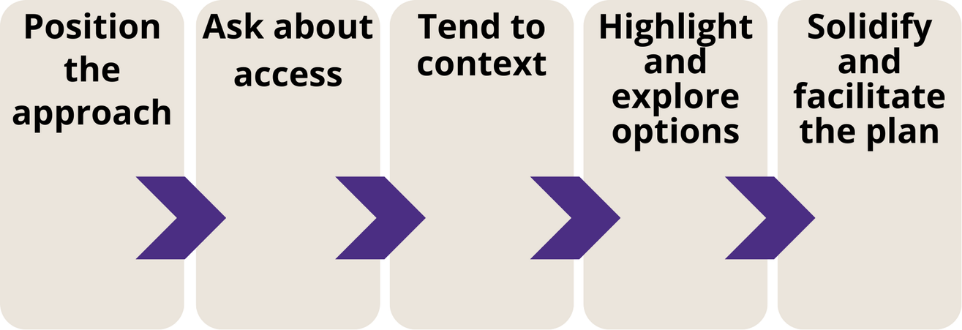
Our PATHS counseling framework was developed in collaboration with clinicians to be culturally resonant and context-specific. Core components include:
- Position the approach
- Ask about access
- Tend to context
- Highlight and explore options
- Solidify and facilitate the plan
Options for Reducing Firearm Access
We also cover state-specific policies and options to reduce firearm access when clinically indicated. These are along a spectrum of restrictiveness, which is how much the client is able to choose what happens to their firearm. It is always our goal to make sure that the client has as much autonomy as possible in this choice. Options we discuss include:
- In-home storage (least restrictive)
- Out-of-home storage
- Voluntary Waiver of Firearm Rights
- Extreme Risk Protection Order
- Involuntary Treatment Act (most restrictive)
Case Examples and Skill Building
We have four current case examples (more coming soon!):
- Working with caregivers of adolescents
- Working with clients with suicidal ideation
- Working with older adults with cognitive decline/dementia
- Working with victim-survivors of intimate partner violence
We also have two client simulations where providers can practice the skills they learn in the training:
- Working with clients with suicidal ideation and substance use
- Working with caregivers of adolescents with complex family dynamics
About the P2S Client Simulation
As part of the P2S training, clinicians and students receive access to simulated practice clients to practice and apply counseling skills related to firearm access and secure storage. These practice clients provide personalized feedback derived from training materials. These simulated practice clients were developed with Noodle’s DialogueAI tool.
Given that AI tools can reproduce and amplify structural racism, bias, and other forms of structural harm, particularly in clinical training, the AI practice clients were trained exclusively on training materials developed for P2S, which were produced with explicit attention to how systems of oppression shape which options are safe for clients with firearm access. This includes how race, gender identity, immigration status, and other intersecting identities affect safety planning conversations.
We are conducting ongoing evaluations of these simulated practice clients to understand their effectiveness and whether clinicians and students want AI tools used in their training or practice.
Evidence
We’ve trained over 600 behavioral health clinicians and trainees in Washington State:
Before P2S
- Nearly 60% had no previous lethal means safety training
After P2S
- 26% increase in firearm safety knowledge
- 67% increase in counseling confidence
- Improved skills in simulated sessions
- Greater endorsement of plans to counsel about firearms
- 98% recommend the training to other clinicians
Frequently Asked Questions
What is the cost of bringing P2S to our agency?
The cost depends on agency size, number of trainings provided, and number of providers being trained. Reach out to us at p2s@uw.edu to schedule a time to talk through pricing.
We have a large number of providers. How many training sessions do you provide?
We’ll work with you to find the right number; most agencies choose at least two sessions, but we’ll add more as needed to reach every provider. Given that P2S is currently delivered with a small trainer to provider ratio, it is most efficient to train a large number of providers at one time.
Are trainings in-person or online?
In-person is strongly recommended for hands-on feedback with demonstration kits, but every agency gets at least one hybrid session for remote clinicians.
Do you cover all lethal means or just firearms?
We focus on firearms — the most lethal means, and the one providers struggle with most — but can cover other lethal means on request.
What makes P2S different from other lethal means safety trainings?
P2S is an agency-level intervention. We tailor content to your existing policies, provide locks and demo kits with hands-on instruction, and cover material you won’t find elsewhere, like state-specific policies and a counseling framework developed with behavioral health providers.
Our clients are prohibited from having firearms. Is P2S still relevant?
Yes! Clients are often reluctant to disclose firearm access, so this is likely more relevant than it seems. For youth-focused agencies, we also cover access assessment with youth and bringing in caregivers.
Who is P2S for?
P2S is currently designed for community behavioral health agencies and their clinicians. However, we are currently working on adaptations for mobile crisis response, among other groups. If you’d like to talk about an adaptation for your setting, reach out to the Pathways 2 Safety team (p2s@uw.edu).